
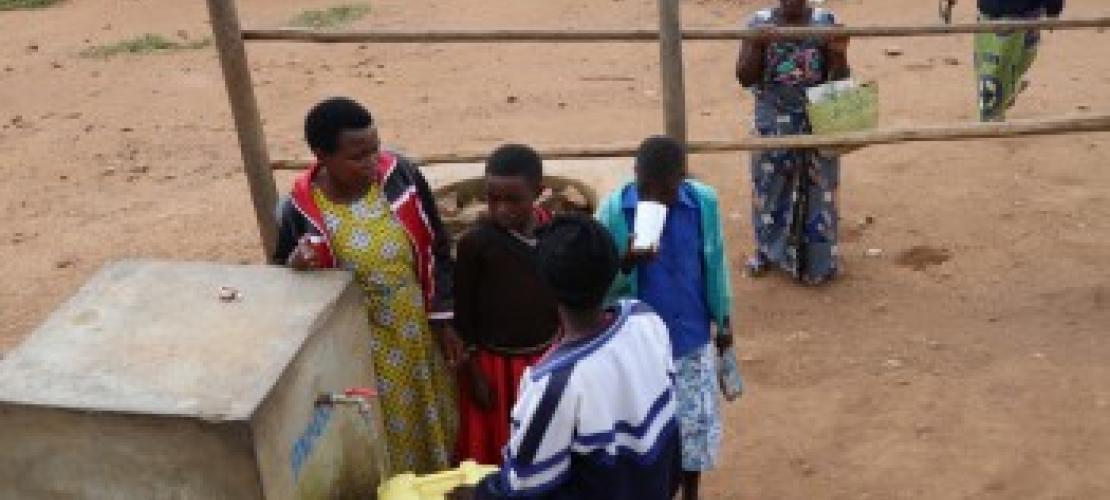
Béatrice lives in the village of Tumba, in the district of Rulindo, in Rwanda. She has six children. Beatrice is overjoyed to narrate how a project funded by the African Development Bank has enabled her community to access clean water.
Beatrice considers it a miracle that she no longer has to walk more than 6 km in search of water. She can now fetch it almost at her doorstep.
“Before the water supply system was completed in this village, life was very difficult, especially for mothers like me who had six dependent children. The nearest water collection point was at the bottom of this hill, about 6 km away, ”said the 40-year-old woman.
“We would wake up early in the morning and endure the long queue at the water point in order to get water for drinking and cooking,” Beatrice stated, adding that sometimes they would buy the commodity at 300 Rwandan francs (about 31 US cents) per 20-liter container.
More than 700,000 residents in the Rulindo district now enjoy access to water from improved wells, and 155,000 others benefit from enhanced sanitation.
The Rulindo district was previously part of the 5.1 million people who lacked decent access to clean water in Rwanda, according to WaterAid.
Using the lessons from this project, the Government of Rwanda requested the African Water Facility to support the development of long-term investment plan to guide the scaling up of inclusive and sustainable access to water supply and sanitation. The Rwandan government, through the Water and Sanitation Corporation (WASAC), received a grant of 1,950,894 euros from the African Water Facility to support the development of a 25-year master plans and investment program for water supply and sanitation.
National water supply and sanitation master plans are essential to mobilize the participation of different development partners in the water and sanitation sub-sector. They should guide the efforts of the Government and all other development partners in the water and sanitation sector to achieve 100% water and sanitation coverage in Rwanda.
Besides the development of national investment Master plans and feasibility studies and detailed designs for small follow-on investments, the project also focuses on capacity building and dialogue with stakeholders.
The project will run until 2023.
Fauzia Haji, the Bank’s Acting Country Manager for Rwanda, said: “Investing in water infrastructure and resources management enables individuals, communities and nations to harness the productive potential of water and makes it more readily available for drinking, sanitation, cooking, irrigating crops, industrial processes, transport, and producing energy.”